
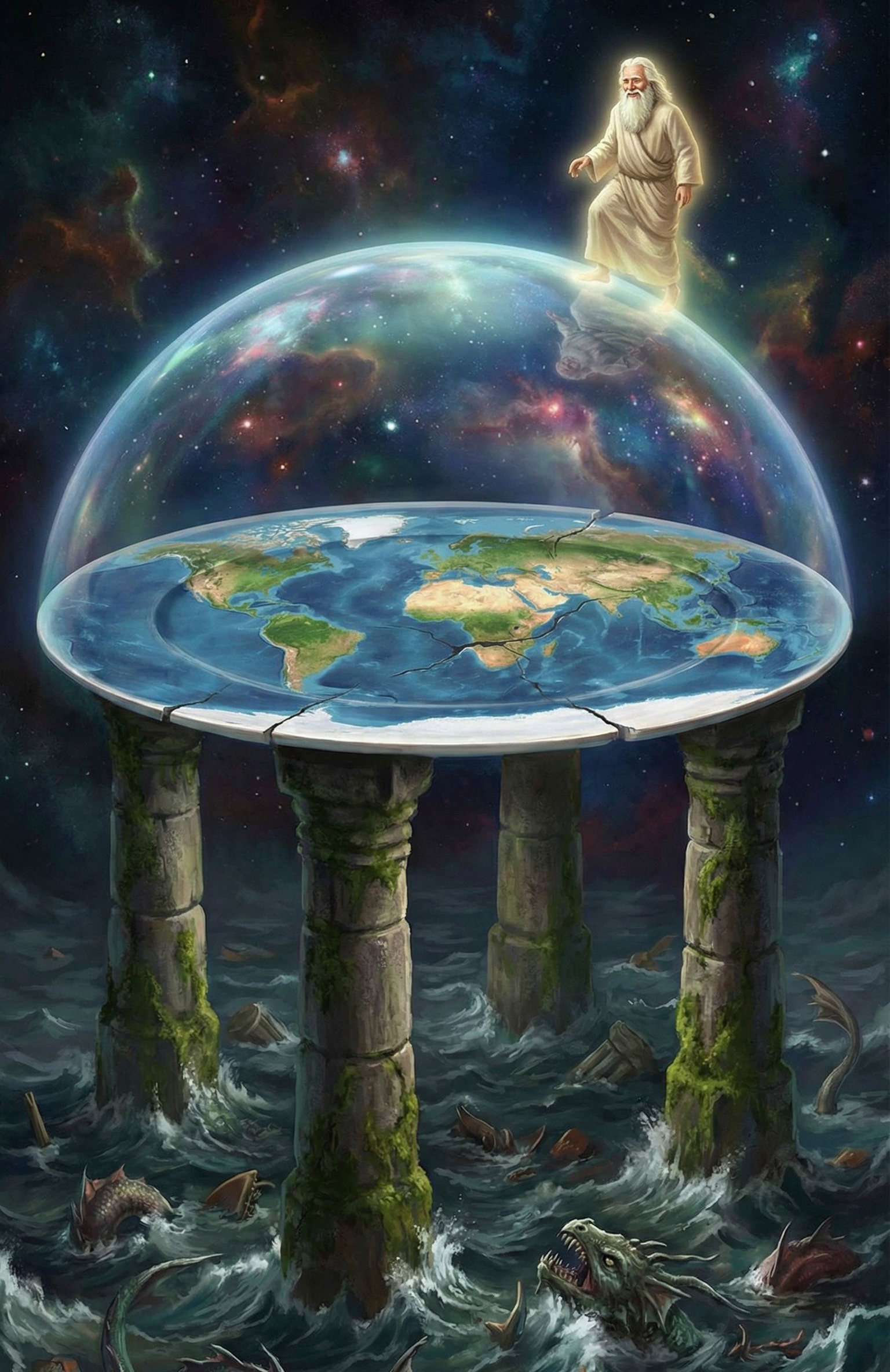
According to the Hebrew Scriptures, the Earth is shaped like a dinner plate, held above the chaos waters by four gigantic pillars, and covered by a hammered metal dome, the "firmament," upon which God walks.
Myth Versus History
The Bible is full of "salvation history," aka myths. History as we define it today, almost zero.
Is the Bible true? If you mean, is the Bible full of theological truth, then yes. If you mean, is the Bible the sort of history that today's world considers factual, then no. The sort of history book that today's world considers a "true account" of a given event was invented during the Enlightenment, just a few hundred years ago.
The Bible is a collection of myths. The TV show "Mythbusters" uses the word as if myths are either fairy tales or urban legends (probably because "Urbanlegendbusters" isn't as easy to say!), but the fact is that myths are NOT FICTION!!! A myth is a sacred narrative that teaches a theological truth in a way that can entertain children, fools, and fundamentalists around a campfire. (Remember, when the Bible was written people had barely just invented writing; virtually all of the first audiences for the Bible were illiterate nomads, while only about 97 percent of the first audiences for the Christian Testament were illiterate.)
At the same time, myths evolved over the centuries to be so jam-packed with theological nuance that they still keep scholars, priests, and other experts entertained too! Remember, in Bible times they didn't even have electricity, much less TV, radio, the Internet, movies, novels, etc. They didn't have three millennia of scientific learning and advancement, as we do; they seriously believed the Earth was flat, shaped like a dinner plate, held up on four gigantic pillars above the waters of chaos below, protected from the chaos waters above by a hammered metal dome called "the firmament" (Gen. 1:8), on top of which God walked (Job 22:14). The stories in both "testaments" of the Bible were written as entertainment that teaches, because which would you prefer at the end of a long, hard day of physical toil: a dry theological lecture in a classroom full of words like aseity, eisegesis, and hermeneutics, or "The Simpsons"?
It is easy to see that the Bible is not a history book with a closer look at the Christian Testament. The four canonical gospels contradict each other all over the place, especially when you team up the synoptics against the Fourth Gospel; the epistles contradict the gospels. (Let's not even get started with the 90 or so non-canonical gospels!) To take just a few of dozens of examples of this non-historicity:
- If an enormous star hung in the sky for the months it would have taken the Magi to get to Israel, why didn't any historian or astronomer outside of Matthew's gospel notice it?
- Why did the star act like a UFO?
- If Herod the Great massacred thousands of babies and toddlers, why didn't every historian in the (Mediterranean) world write about this enormity in passionate indignation?
- Did the Last Supper take place on the first night of Passover or the night before?
- Was it most Jews' Passover, or the Passover of the Essenes two days before?
- For his trial, was Jesus taken first to the high priest, or was he taken first to the father-in-law of the high priest? (Bonus question: Why the father-in-law?)
- Was there or was there not an earthquake on the day Jesus died? Scholars think the Crucifixion happened around 30 CE, but argue for anywhere from 27 to 32. Historians outside the Bible would have noticed an earthquake as dramatic as the one Matthew describes, so if Matthew's earthquake had happened in The Real World, we'd know exactly which day Jesus was crucified. Not to mention the ensuing zombie apocalpse (Matthew 27:50-53).
And consider the Resurrection, the sine qua non of Christianity itself.
- Who found the empty tomb? — (a) Mary Magdalene, Mary the mother of James, and Salome; (b) MM and "the other Mary"; (c) five or more of "the women who had come with [Jesus] out of Galilee" (roughly a two-week journey); or (d) Mary Magdalene all by her lonesome?
- Whom did she/they meet at the tomb? Was it (a) a young man (16 to 24 years old) in a white "linen," i.e., sheet; (b) an angel; (c) two men in dazzling apparel; or (d) Jesus himself?
- Whom did Mary and/or the other women tell about what they had seen? (a) No one; (b) the other disciples, i.e., the men; (c) "the Eleven and all the rest"; or (d) did Mary just say, "I have seen the Lord"?
- What happened next? (a) Nothing (Mark, the earliest-written canonical gospel). (b) Jesus ascended to Heaven from Bethany on the day he was Resurrected by God (Luke). (c) Jesus ascended to Heaven from Mt. Olivet (in eastern Jerusalem) six weeks after the Resurrection (Acts). Or did Jesus boing back and forth between Earth and Heaven like a bungee jumper?
The gospel accounts vary because the gospel writers weren't writing history, they were writing theology. Mark, the earliest gospel writer (around 70 CE), chose Psalm 22 for his framework, and Matthew (around 85 CE) and Luke (around 120 CE) were happy to use the same hermeneutic. The Gospel of John (around 130-50 CE) seems never to have seen Q, Mark, proto-Matthew, Matthew, proto-Luke, or Luke, but a scholar named Elaine Pagels has proved (to my satisfaction, anyway) that the Fourth Gospel was written specifically to rebut the non-canonical Gospel of Thomas (around 50 CE, the earliest of all gospels). The author of the Gospel of Thomas thought that Jesus was supremely wise, but not that he was "God in a man-suit." The author of John was convinced that the collection of Jesus's wisdom in the Gospel of Thomas was just not the point.
In the ancient world that produced the Bible, a fable was "false history," while a myth was "true history" — not history as you and I think of history, with names, dates, Social Security numbers, birth certificates, photos, videos, etc., but rather the kind of "true history" that Parson Weems wrote in 1809 when he made up the myth about the boy George Washington chopping down the cherry tree. This incident never happened in The Real World, but teachers still teach it as if it were history (that's where I learned it, anyway!), because the myth teaches important truths about some of the things Americans value as a society: honesty, courage, respect for one's parents, even environmentalism.
Even if every single word of the Christian Testament were literally, historically factual — an impossibility — it would still be a collection of myths, many of which are retreads of earlier myths about Mithras, Dionysus, Osiris, and Tammuz. That does NOT make them either fiction or wrong! The brutal fact is that we have no historical evidence that Jesus even existed in The Real World. (The alleged passage in Josephus was a later Christian interpolation.) Every important teaching of Jesus can be found in the Hebrew Scriptures, even the two Great Commandments.
We can be pretty sure that Jesus existed, and that he was crucified by the Roman Empire for the crime of sedition. The myths of the Christian Testament teach us what Jesus's earliest followers believed to be the most important theological truths connected by his life and what they believed to be the Truth about his afterlife, and as Mike Miller reminds us, his continuing life today.
Is the Christian Testament factual? No. Is it true? Yes!
1411 : /Christianity/myth-vs-history.php : 26Apr14
This is content that OUGHT to be replaced.